
How to Use This Guide
Select a material category tab and use the search bar to filter by chemical name. Tap or hover the i indicator beside any column header for material details. Some chemicals also show an i icon — tap or hover for concentration and temperature-specific notes.
Temperature Matters
Ratings are based on ambient temperature (~20°C). Elevated temperatures can dramatically reduce a material's chemical resistance. A material rated "Excellent" at 20°C may fail at 80°C. For guidance on how temperature interacts with flange pressure class, see our Pressure-Temperature Ratings guide.
Concentration Matters
Where concentrations are not specified, ratings assume moderate/standard levels. Concentrated acids and alkalis behave very differently to dilute solutions — we've split key chemicals where data differs significantly.
Mixtures Are Not Listed
Real-world process fluids are rarely pure chemicals. Mining reagents, proprietary solvents, and chemical cocktails can behave unpredictably. If your application involves mixed fluids, contact us for validated testing.
Formulation Matters
Many of the materials listed here represent generic families (e.g. "EPDM" or "FKM") rather than specific compounds. In practice, different manufacturers' formulations of the same material type — and even the same brand produced at different manufacturing sites — can vary significantly in chemical resistance, hardness, and service life. Always confirm the specific compound grade for your application.
Compatibility Table
We publish this data as a general starting point only — it does not constitute material advice, recommendation, or specification. Actual chemical resistance depends on compound formulation, concentration, temperature, exposure duration, and other service conditions not reflected in these generic ratings. Where an i icon appears, tap or hover for chemical-specific notes.
Caution — Limited Resistance
shows limited resistance to .
Performance depends heavily on concentration, temperature, and exposure duration. This combination may be acceptable for low-temperature, short-duration, or dilute applications — but should be validated for critical service.
No Standard Data Available
We don't have published compatibility data for with .
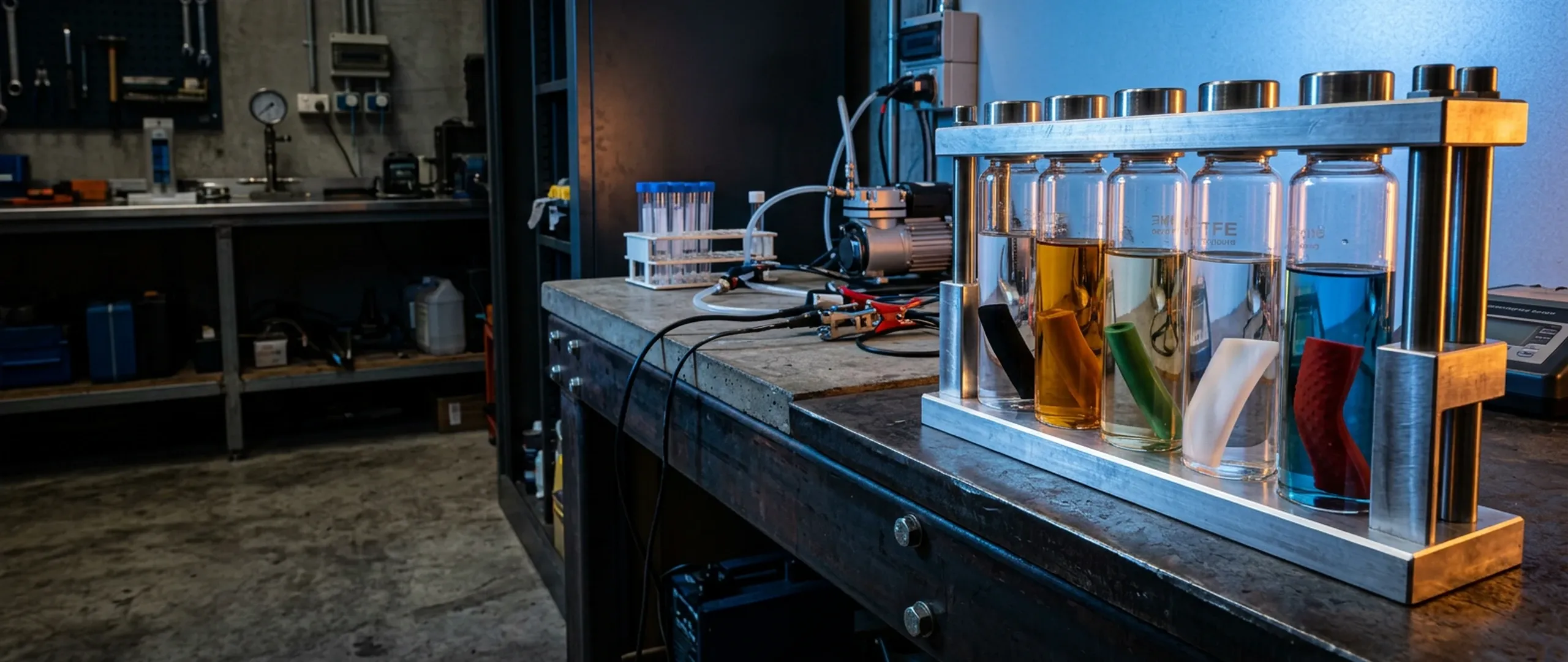
This doesn't necessarily mean incompatibility — the combination may simply lack published test data. We can arrange immersion testing to ISO 1817 (elastomers) or ASTM D543 (plastics/rigid materials) to validate this combination for your application.
Understanding the Ratings
Our ratings reflect a material's general resistance at ambient temperature and standard concentrations. They sit in three risk tiers, so you can quickly see whether to proceed, validate, or rule out a combination.
Green Zone
Excellent & Good
Standard industry data confirms a well-established compatible pairing. Material is suitable for general service with this chemical at normal temperatures and concentrations. Proceed with confidence for standard applications.
Amber Zone
Poor / Caution
Limited resistance. May be acceptable for specific conditions (low temperature, short duration, dilute concentration) but risks swelling, degradation, or reduced service life. Click any amber cell for guidance. Confirm suitability with our team.
Red & Grey Zone
Do Not Use & No Data
Red: Known incompatibility — material will swell, degrade, or dissolve. Do not use.
Grey: No published test data. Click any grey cell to request immersion testing through our accredited laboratory partners.
Don't Guess — Test
Generic compatibility data is a starting point, not a specification. When your application demands certainty, we coordinate validated immersion testing through NATA-accredited laboratories.
When Generic Data Isn't Enough
- › Your process fluid is a proprietary blend, mixture, or uncommon chemical
- › Service temperatures, concentrations, or pressures exceed standard reference conditions
- › Published compatibility data for your material-chemical combination is limited or unavailable
- › Conditions are borderline — where small variations in environment could affect seal performance
- › You need documented evidence of material suitability for quality records, audits, or regulatory compliance
Testing Standards
Elastomers (Rubber)
ISO 1817 / AS 1683.23
Measures volume swell (%), mass change, and mechanical property retention after immersion. The definitive standard for rubber seal validation.
Plastics & Rigid Materials
ASTM D543
Measures weight, dimensional, and tensile strength changes after 7-day immersion. Applies to PTFE, phenolics, CNAF (compressed non-asbestos fibre), and engineering plastics.
Send us a sample of your process fluid and we'll coordinate testing with NATA-accredited (National Association of Testing Authorities, ISO/IEC 17025) laboratory partners. You'll receive a formal test report documenting material performance under your exact service conditions. The report is suitable for quality records, audits, and regulatory submissions.
Request Compatibility TestingExplore Further
Disclaimer
This resource is provided for general engineering reference only and does not constitute professional advice, specification, or guarantee of performance. Actual results depend on specific application conditions. Universal Gaskets Pty Ltd accepts no responsibility or liability for decisions made based on this information. For full terms, see our Terms & Conditions.
This compatibility data is compiled from publicly available industry sources and is provided for preliminary reference purposes only. Liability for material selection decisions, product failures, consequential losses, or damages of any kind arising from the use of or reliance upon this information is excluded to the maximum extent permitted by law. Actual material performance depends on the specific compound formulation, chemical concentration, operating temperature, pressure, exposure duration, and other service variables that are not captured by general compatibility ratings. Users must independently verify the suitability of any material for their specific application through appropriate testing, consultation with material manufacturers, and their own engineering judgement. For critical, safety-sensitive, or regulated applications, we strongly recommend validated immersion testing to applicable standards (ISO 1817, ASTM D543).