
Manufacturing Tolerances
DIN 7715-5, ISO 3302-1, and ISO 2768-1 general tolerances for gasket manufacturing. Interactive tolerance checker, reference tables, and practical guidance across cut, extruded, and rigid materials.
Choosing the Right Standard
This page covers the four tolerance standards that apply to gasket manufacturing, with reference tables and an interactive checker to confirm the right choice for your application.
Why it matters: when a drawing specifies the wrong standard, or an unnecessarily tight precision class, you get rejection disputes, rework, and higher costs for no improvement in seal performance. The correct standard depends on the material being manufactured.
Three standards cover most of what we manufacture: DIN 7715-5 for cut rubber and soft sheet, ISO 3302-1 for extruded rubber profiles, and ISO 2768-1 for rigid materials. A fourth standard — ARPM (Association for Rubber Products Manufacturers, formerly RMA) — applies specifically to die-cut rubber parts and is common on US-origin drawings.
DIN 7715-5
Cut parts — soft & elastic
For parts cut or punched from rubber and soft sheet materials. Defines tolerance classes P1, P2, P3 that account for flexibility and compressibility during cutting and measurement.
ISO 2768-1
Rigid & semi-rigid materials
General tolerances for linear and angular dimensions. Defines Fine, Medium, Coarse, and Very Coarse classes for dimensionally stable materials: metals, PTFE, and engineering plastics.
ISO 3302-1
Extruded rubber profiles
Dimensional tolerances for extruded rubber profiles (E classes for cross-section, L classes for cut length). Applicable to EPDM seals, silicone strips, and custom-profile extrusions.
ARPM / RMA
Die-cut rubber (US system)
The American system for die-cut rubber tolerances. Classifies by material type (BL1/BL2/BL3) rather than precision grade. Common on US-origin drawings, and broadly comparable to DIN 7715-5 for solid rubber.
Standard Selection by Material
Material Hardness Continuum
Cut parts (soft)
Natural rubber (NR), Nitrile (NBR)
EPDM, Neoprene (CR), Viton (FKM)
Silicone (VMQ), Butyl (IIR)
Foam & sponge rubber, cork rubber
Rigid materials
Metals & alloys (316SS, aluminium)
PTFE, POM (Delrin), nylon
Phenolic, polycarbonate, rigid PVC
UHMWPE, glass-filled composites
Manufacturing Process
Extruded profiles
EPDM profiles & seals
Silicone strips & tubing
Neoprene extrusions
Custom-profile rubber sections
Extrusion tolerances are determined by the manufacturing process (die swell, vulcanisation shrinkage), not by material hardness. The same rubber compound will have different tolerances when cut from sheet versus extruded as a profile.
Why Material Matters
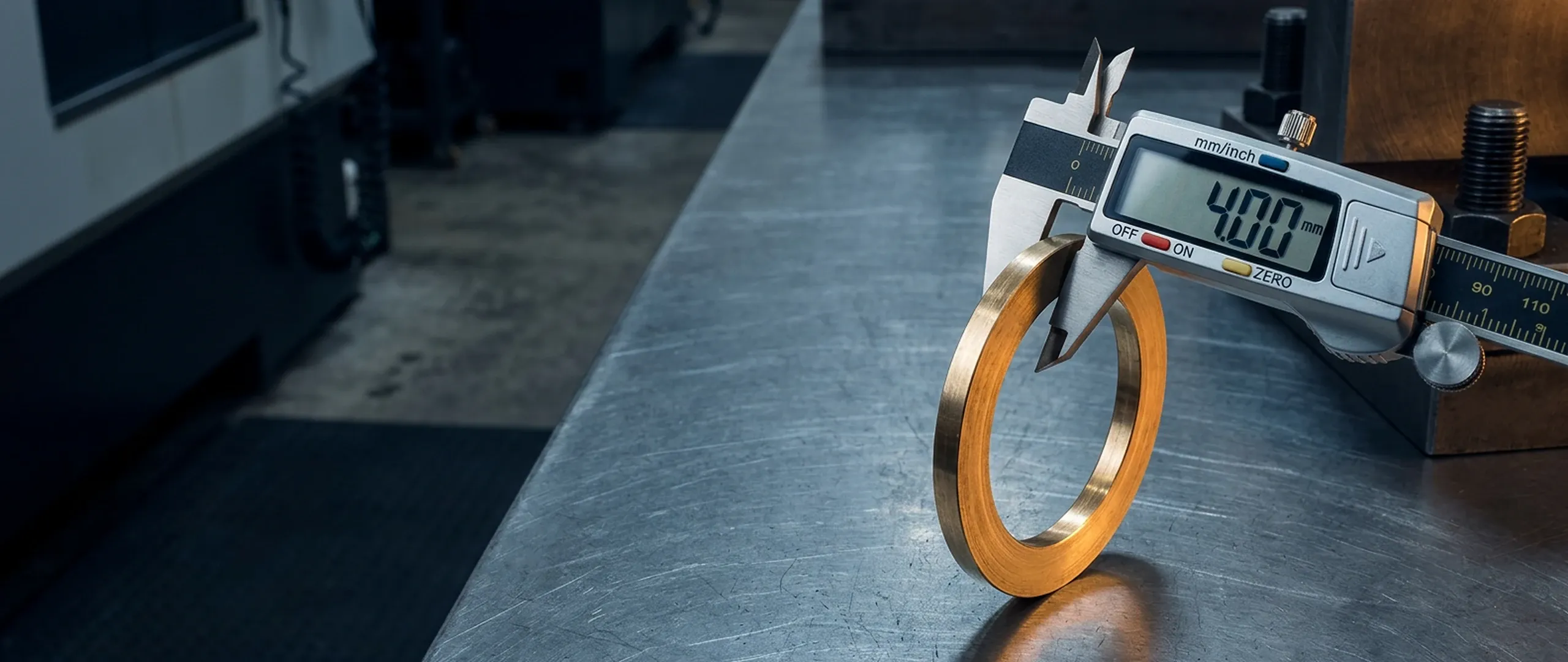
Soft and elastic materials deform under measurement pressure. Calipers can unintentionally compress a rubber gasket, making tighter tolerances difficult to verify reliably. DIN 7715-5 accounts for this by defining tolerances that we can reliably achieve in cutting and confidently verify during inspection.
Extruded rubber profiles have their own dimensional challenges: die swell, shrinkage during vulcanisation, and cross-sectional variation along the length. ISO 3302-1 E classes address these specific process characteristics separately from the material-hardness continuum.
For rigid materials (metals, PTFE, and engineering plastics), ISO 2768-1 is appropriate because they are dimensionally stable and we can measure them accurately with standard instruments.
Reference Tables
Full tolerance tables for all three standards. Click a class card to highlight its column. The active tab syncs with your Tolerance Checker selection below.
DIN 7715-5 — Cut Part Tolerances
Permissible deviations for parts cut, punched, or punch-cut from rubber and soft sheet materials. Click a class to highlight its column. All values in mm unless noted.
Click a class card to highlight its column. Click again to deselect.
Source: DIN 7715 Part 5: Tolerances for cut, punched, and punch-cut rubber parts from sheets/plates.
ISO 3302-1 — Rubber Dimensional Tolerances
The international standard for dimensional tolerances on moulded, extruded, and calendared rubber products. The tables below cover E classes (extruded cross-sections) and L classes (cut lengths), the two most relevant to gasket and seal profiles we manufacture. Click a class to highlight its column. All values in mm unless noted.
Click a class card to highlight its column. Click again to deselect.
Source: ISO 3302-1, Rubber tolerances for products, Part 1: Dimensional tolerances (E classes for extruded profiles).
Extrusion Cut-Length Tolerances (L Classes)
If you are specifying the cut length of an extruded profile, these tolerances apply separately from the cross-sectional tolerances above. All values in mm unless noted.
Source: ISO 3302-1, Rubber tolerances for products, Part 1: Dimensional tolerances (L classes for cut lengths of extruded profiles).
What Else ISO 3302-1 Covers
ISO 3302-1 also defines tolerance classes for moulded rubber, mould flash and finish, calendared sheet thickness, and die-cut parts that we have not reproduced on this page:
- M classes (M1–M4) — moulded rubber dimensions, with separate values for Fixed (F) and Closure (C) dimensions.
- X classes (X0–X5) — flash height and extension on moulded parts, from precision (X1, ≤0.10 mm) to non-critical (X5, no limit).
- F classes (F1–F4) — ARPM mould-surface finish grades, from polished (F1, Ra ≈0.4 µm) to dull blasted (F4).
- ST classes (ST1–ST3) — calendared sheet thickness tolerances. Sheet supplier sets the grade for stock material.
- ARPM BL classes — die-cut and waterjet-cut tolerances on length and width, with the relevant class set by part thickness.
- ISO 3601-1 / ISO 3601-3 — O-ring dimensional tolerances and quality acceptance criteria (Class A/B, Grade N/S/CS).
We can manufacture and inspect to any of these classes on request — the tables on this page show the most commonly referenced grades for the work we do day to day. If your drawing calls out a class we have not tabulated here, include it in your enquiry and we will quote against it directly.
ISO 2768-1 — General Tolerances
The international standard for general tolerances on linear and angular dimensions without individual tolerance indications. Australian engineering drawings widely reference ISO 2768-1, and the industry accepts it as the general tolerance standard for rigid materials. These tolerances apply to dimensions that do not carry an individual tolerance callout on a drawing, and are appropriate for rigid, dimensionally stable materials.
Click a class card to highlight its column. Click again to deselect.
1. Linear Dimensions
2. External Radii & Chamfer Heights
3. Angular Dimensions
1° = 60 minutes of arc (60')
Tolerance Checker
Enter your material type, tolerance class, and nominal dimension to instantly look up the applicable tolerance. Results reference the full tables above.
Step 1 — Material Type
Step 2 — Tolerance Class
Step 3 — Nominal Dimension
Result
Tolerance
Minimum
Maximum
Matched range: (percentage-based for this range)
No tolerance data available for this dimension and class combination. Check the reference tables above or contact our team for guidance.
Cost vs Precision
Tighter tolerances increase cost through slower cutting speeds, additional quality checks, and higher reject rates. P2 / E2 / Medium is appropriate for the vast majority of gasket applications. Reserve finer classes for critical seal interfaces where dimensional accuracy genuinely affects performance.
Standard Comparator
Drawings frequently call out ISO 2768-1 (the general machining standard) for soft rubber gaskets, specifying a tolerance band that's impossible to verify reliably on compressible materials. This table compares ISO 2768-1 Class m and DIN 7715-5 P2 across common gasket dimension ranges to show exactly how much the two standards differ. ISO 3302-1 E2 (extruded rubber) tolerances generally fall between these two, closer to the DIN values.
What This Means
DIN 7715-5 P2 allows 3–5× wider tolerances than ISO 2768-1 Class m for the same dimension range. This isn't a sign of poor quality; it reflects the physical reality of cutting and measuring soft, compressible materials. Soft rubber deforms under measurement pressure, and the tighter ISO 2768-1 values become difficult to verify reliably on these materials.
If your drawing specifies ISO 2768-1 Class m for a soft rubber gasket: The gasket will still seal perfectly within DIN 7715-5 P2 tolerances. Applying ISO 2768-1 Class m to soft materials creates unnecessary rejection risk and higher costs — with no improvement in seal performance. The material simply cannot be measured to that level of confidence. We recommend discussing tolerance requirements with our team.
RMA / ARPM Die-Cut Standards
The ARPM (formerly RMA) die-cut tolerance standard uses a different classification system from DIN 7715-5. While DIN classes (P1/P2/P3) are precision grades, ARPM classes (BL1/BL2/BL3) are material-type categories, each with its own tolerance table.
BL1 — Thin Film
Thin-gauge rubber film (typically calendered). Used for diaphragms, thin gaskets, and precision die-cut components.
BL2 — Solid Rubber
Standard solid rubber sheet > 0.8 mm. Covers the vast majority of die-cut gasket applications, and is the most commonly referenced BL category.
BL3 — Sponge & Cellular
Sponge, expanded, and cellular rubber. Looser tolerances reflect the inherent compressibility and dimensional variability of cellular materials.
How Do ARPM and DIN Compare?
For solid rubber (BL2), the most common category for gasket cutting, ARPM tolerances are broadly comparable to DIN 7715-5 P2/P3 across common dimension ranges. However, the two systems use fundamentally different classification approaches: DIN grades by precision, ARPM grades by material type. A direct 1:1 mapping is not technically accurate.
If your drawings reference ARPM or RMA classes, include the BL category and tolerance class in your enquiry. We manufacture to DIN 7715-5 and can confirm the practical equivalence for your specific application.
Practical Guide
Specifying the right tolerance class isn't just about reading a table. It depends on what the material does under the cutter and under the caliper. Here's what you need to know about the factors that determine which class is realistic for your parts.
Material Considerations
Rigid Materials
Metals, engineering plastics (e.g. nylon, polycarbonate, PTFE), rigid composites
Dimensionally stable and repeatable under measurement. We apply ISO 2768-1 classes directly to these materials, and our CNC cutting reliably achieves Fine or Medium class.
Soft & Elastic Materials
Rubber, silicone, foam, soft polyurethane, cork rubber composites
These materials deform under measurement pressure, making tight tolerances difficult to verify. Shore hardness directly affects what we can reliably achieve, which is why we apply DIN 7715-5, not ISO 2768-1, to these parts.
Thermal Expansion
All materials, especially polymers
Polymers expand significantly more than metals when heated, typically 5–15 times more. Parts we manufacture within tolerance at ambient temperature may measure at different dimensions after transport, storage, or in service.
Moisture Absorption
Paper-based gaskets, cork composites, compressed fibre materials
Hygroscopic materials absorb moisture from the environment, causing dimensional swelling of up to 3% (grade-dependent). Parts may measure within tolerance when we dispatch them, but can drift as they equilibrate to ambient conditions at your site. This is typically the larger environmental effect.
Measurement Conditions
Measurement conditions affect whether a part reads within tolerance, especially for soft rubber, which responds to temperature and to the cure cycle itself. The following timing and conditioning rules apply when verifying parts against the tolerance classes on this page.
- Wait time after vulcanisation. For solid rubber products, dimensional measurements should not be taken until at least 16 hours after vulcanisation; this is extended to a minimum of 72 hours in cases of dispute, per ISO 23529.
- Inspection window. Measurements should be completed within 3 months of despatch, or before the product is put into use, whichever is shorter. Rubber properties drift on the shelf even before installation.
- Temperature. Condition and measure rubber parts at 20–25 °C per ISO 23529. For rigid materials, the standard reference temperature is 20 °C per ISO 2768-1. Allow parts manufactured or stored at significantly different temperatures to equilibrate before inspection.
- Storage and handling. Store and preserve rubber products in accordance with ISO 2230 to keep them within tolerance during the inspection window. Do not distort the part during measurement.
For soft rubber specifically, ISO 23529 also specifies the gauge foot pressure used during measurement (22 kPa ± 5 kPa for hardness ≥35 IRHD, 10 kPa ± 2 kPa below that). If your inspection method differs, results may not match our outgoing QC values.
Worked Example — Environmental Dimensional Changes
Consider a 1000 mm part manufactured in winter at 10 °C and 30% relative humidity (RH), then measured in peak summer at 35 °C and 80% RH. That is a 25 °C temperature swing with a significant increase in humidity.
Values are approximate and vary by grade. Coefficient of thermal expansion (CTE): 316SS ≈ 16 × 10⁻⁶/°C, PTFE ≈ 120 × 10⁻⁶/°C, compressed fibre ≈ 20 × 10⁻⁶/°C, PA6 (Nylon 6) ≈ 80 × 10⁻⁶/°C. Moisture swell is grade-dependent; PA6 is notoriously hygroscopic (~8% saturation absorption).
These dimensional changes are a normal property of the material, not a manufacturing defect. We recommend inspecting goods promptly on receipt, while conditions are closest to those at manufacture. If your application involves large parts, tight clearances, or assemblies using dissimilar materials, consider accommodating potential environmental dimensional changes in your design.
Please refer to our Terms & Conditions for inspection and acceptance requirements.
Thickness Tolerances
Thickness tolerance is governed by the sheet manufacturer's standard. It is separate from the cutting tolerance we apply to the part profile.
Soft & Elastic Materials
Sheet thickness is set by the sheet manufacturer, typically to ISO 3302-1 Class ST2 or ST3 (sheet thickness classes, separate from the E and L profile classes). It is independent of the profile tolerance we apply during cutting. For standard stock, we inherit the sheet supplier's thickness tolerance. If your application requires a non-standard or precision thickness, include that requirement in your enquiry — we can source specialist materials.
Rigid & Semi-Rigid Materials
For metal sheet and plate, the relevant supply standard governs thickness tolerances: AS/NZS 1734 (aluminium sheet and strip), ASTM A240 / EN 10029 (stainless steel sheet and plate), ASTM A36 (carbon structural steel). Engineering plastics (PTFE, nylon, acetal) come to us with thickness tolerances set by the grade and supplier. In all cases, the thickness tolerance is independent of the cutting tolerance we apply to the part profile.
Universal Gaskets Policy
Unless your drawing specifies a different tolerance class, these are the defaults we apply to every order. If your application needs tighter control, call it out in your enquiry.
Soft & Elastic
DIN 7715-5 P2 (Medium)
Rubber, cork, foam, compressed fibre, and other compressible sheet materials. P1 (Fine) available on request.
Extruded Rubber
ISO 3302-1 E2 (Medium)
EPDM profiles, silicone strips, and custom extrusions. E1 (Fine) available on request. Cut lengths default to L2.
Rigid & Semi-Rigid
ISO 2768-1 Class m (Medium)
PTFE, metals, engineering plastics, and rigid composites. Fine class available on request.
As per our Terms & Conditions, these defaults apply unless a different class is specified on the drawing or purchase order.
Where your drawing specifies individual tolerances on critical dimensions (e.g. ∅90 ±0.05), those tolerances always take precedence over the general class defaults above. If your project requires tighter controls, highlight this in your enquiry.
Explore Further
Disclaimer
This resource is provided for general engineering reference only and does not constitute professional advice, specification, or guarantee of performance. Actual results depend on specific application conditions. Universal Gaskets Pty Ltd accepts no responsibility or liability for decisions made based on this information. For full terms, see our Terms & Conditions.
Tolerance values are reproduced from DIN 7715-5, ISO 3302-1, and ISO 2768-1 for convenience; always refer to the current published edition of the relevant standard for authoritative data. Actual achievable tolerances depend on material type, hardness, part geometry, and manufacturing method. The material boundaries between standards are approximate, so contact our team for guidance on borderline materials.