
Installation Overview
Proper flange gasket installation is critical for achieving leak-free bolted joints in pressure systems. The majority of gasket failures are traced not to material defects but to improper installation — particularly incorrect bolt tightening sequences and torque application.
A correctly installed gasket creates uniform compression across the entire sealing surface. This prevents flange warping, gasket extrusion, and the formation of leak paths. Conversely, poor technique can damage even the highest-quality gaskets.
Important
This guide is an introductory overview only. It is not a substitute for formal training, certification, manufacturer's guidelines, site-specific procedures, or applicable codes and standards. Improperly installed gaskets can cause dangerous leaks, equipment damage, and serious injury. Qualified personnel only, following approved procedures.
Standards & Guidelines
Several international standards provide detailed guidance on flange joint assembly, covering surface preparation, bolt tightening methods, torque calculation, tooling, and inspection. Always consult the applicable standards for your application and jurisdiction.
ASME PCC-1
Pressure Boundary Bolted Flange Joint Assembly
The primary reference for bolted flange joint assembly. Covers tightening sequences, torque methods, gasket seating stress, and quality control.
API 601 (Withdrawn)
Metallic Gaskets for Raised-Face Pipe Flanges
Originally covered metallic gaskets for refinery pipe flanges. Withdrawn in 1988 and absorbed into ASME B16.20. Referenced here for legacy documentation only.
EN 1591-4
European Standard
European standard covering design, calculation, and assembly of bolted circular flange connections. Part 4 addresses assembly procedures and tightening methods.
Note: This guide demonstrates the sequence pattern based on ASME PCC-1. Detailed requirements — torque tables, lubrication specifications, surface finish tolerances — must be obtained from the applicable standards. Modern methods (controlled-yield, ultrasonic tensioning) may differ.
Surface Preparation
Both the flange faces and the gasket must be clean, undamaged, and suitable for service. Inspect and prepare all components before assembly.
Flange Face Inspection
- 1. Check for pitting, scoring, warping, or corrosion on sealing surfaces
- 2. Verify surface finish meets gasket manufacturer requirements (typically 3.2–6.3 µm Ra for soft gaskets, 1.6–3.2 µm Ra for metallic)
- 3. Check flange flatness using a straight edge and feeler gauge
- 4. Radial scratches are generally acceptable; circumferential scratches create leak paths
Cleaning
- 1. Remove all old gasket material using brass scrapers, wire brushes, or approved solvents — never use steel tools on soft flanges. Always brush in the direction of the flange face grooves and use non-ferrous tools (e.g. brass drift) to avoid damaging the sealing surface
- 2. Clean all rust, scale, paint, and corrosion from sealing surfaces
- 3. Degrease with approved solvents (ensure compatibility with gasket material)
- 4. Do not touch cleaned surfaces with bare hands — skin oils can cause leaks
Important
Ensure the gasket is installed in a dry state. Moisture, lubricant, or solvent residue on the sealing face can reduce sealing performance and promote gasket degradation in service.
Gasket & Bolt Inspection
- • Verify gasket is the correct size, style, and material. Inspect for damage or foreign material
- • Never reuse gaskets — always install a new gasket on reassembly
- • Check all bolts for damaged, corroded, or stretched threads. Verify same length, grade, and material
- • Clean and lubricate threads per procedure — lubrication dramatically affects achieved bolt stress
Important
Never reuse a gasket. The cost of a replacement gasket is minimal compared to the cost of unplanned downtime, leakage, or environmental incidents caused by a failed seal. Once a joint is broken, always install a new gasket — even if the old one appears undamaged.
Workshop Note
Before installing the gasket, verify flange alignment. Check for pipe strain, parallelism, and bolt hole alignment. Use feeler gauges to measure flange gap uniformity around the circumference. Misaligned flanges will prevent uniform compression regardless of torque.
Torque Values
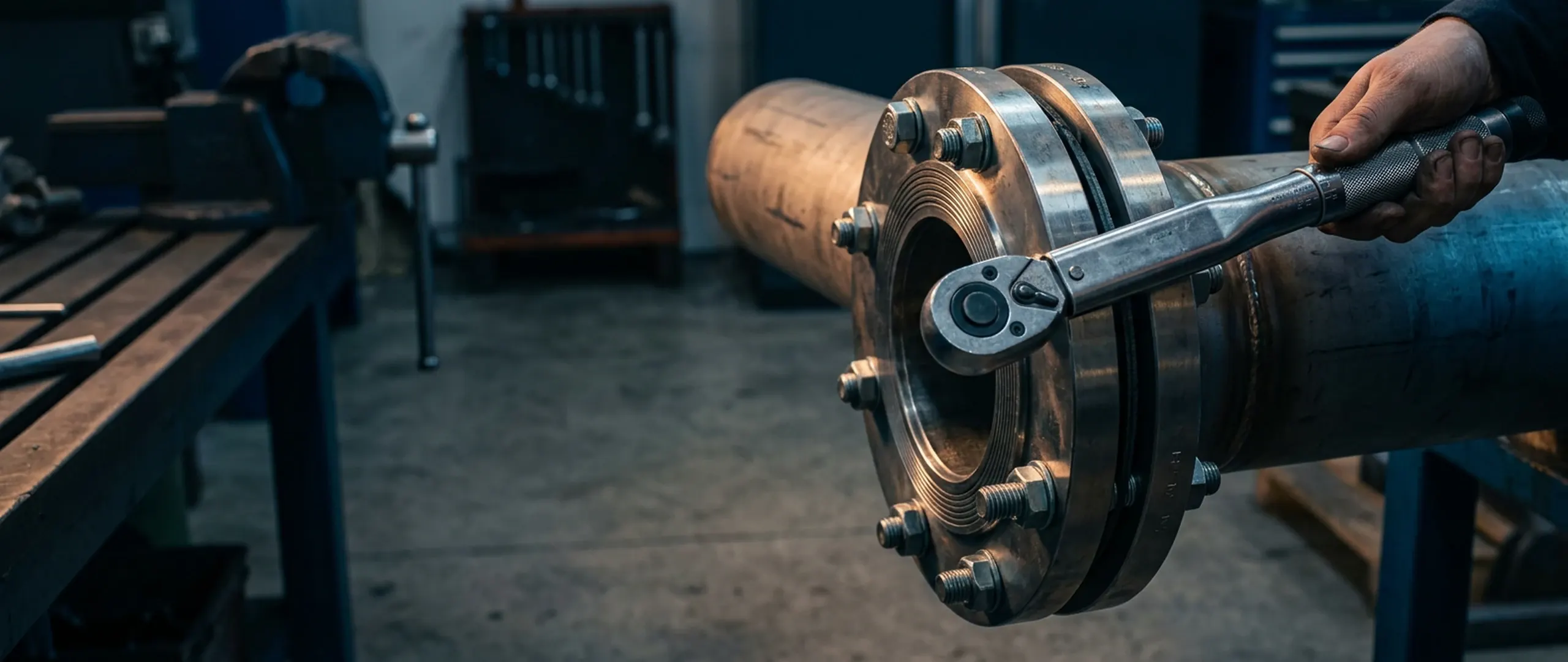
Bolt torque values are not generic. The correct torque depends on bolt size, material grade, thread condition, lubrication, gasket type, flange class, and service conditions. Do not use "rule of thumb" torque values — requirements must be calculated based on the specific bolt and gasket combination.
Key Factors
- • Bolt properties: Diameter, material, proof strength (ASME PCC-1 Appendix O). Nut proof load, washer selection, and bolt grade must all be considered per the applicable standard
- • Gasket seating stress: From manufacturer data sheets
- • Lubrication: Dry vs. lubricated bolts can produce 30–50% difference in achieved stress at the same torque. Apply lubricant consistently and do not substitute without recalculating
- • Tooling: Use calibrated torque wrenches within their 20–80% accuracy range. For large or critical bolts, consider hydraulic tensioners
Workshop Note
Apply lubricant to bolt threads and nut faces only — take care that lubricant does not contaminate the gasket or flange sealing surfaces. The lubricant’s rated service temperature must be within the process temperature limits.
Common Mistakes
- × Using generic torque charts without accounting for actual assembly conditions
- × Applying torque in a single pass to 100% — use a multi-pass tightening sequence
- × Using impact wrenches on critical joints (torque cannot be accurately controlled)
- × Exceeding 80% of bolt yield strength (no safety margin, risks bolt failure)
Workshop Note
In our experience supporting plant maintenance teams, the single most underestimated variable in bolt torque is lubrication. We've seen cases where the same torque value produced wildly different bolt loads simply because one crew used moly paste and another used copper anti-seize. The nut factor (K-factor — the coefficient relating applied torque to actual bolt load) can vary by over 50% between lubricant types. Our engineers always ask: "What lubricant are you using, and does your torque table account for it?" If the answer is uncertain, the torque value is meaningless.
Engineering calculation required: This guide does not provide specific torque values. Torque must be calculated by a qualified engineer based on the specific application, following ASME PCC-1 Appendix O or equivalent. Contact Universal Gaskets if you need assistance.
Verification & Testing
A correctly tightened joint holds torque on the final clockwise check, shows a uniform flange gap, and has no visible gasket extrusion. The checks below cover what to look for before releasing the joint for service.
Visual Inspection
- • Gasket seated evenly with no visible gaps or extrusion
- • Flange gap is uniform around circumference (use feeler gauges)
- • For spiral-wound gaskets: outer ring should not be fully collapsed
Leak Testing
- • Hydrostatic test: Pressurise with water (safest method, typically 1.5× design pressure)
- • Pneumatic test: Low-pressure air (stored energy hazard — follow safety protocols)
- • Bubble test: Apply soap solution and look for bubbles under pressure
Verification Pass
After the final 100% torque pass, perform a full verification pass:
- Re-apply 100% torque to every bolt in sequential (clockwise) order.
- If any bolt moves, repeat the full verification pass.
- Continue until no bolt tightens further at 100% torque.
Only then is the joint properly seated.
For critical applications, allow the joint to rest (e.g. 4 hours) and then perform another verification pass. Gasket creep and bolt relaxation can cause load loss during this period, and re-verification ensures the joint is still at full torque before being put into service.
Workshop Note
We always recommend that our customers perform a re-torque pass 4 to 24 hours after initial bolt-up, especially on soft gaskets like PTFE or compressed fibre. In our testing, we've measured bolt load losses of 10 to 15% in the first few hours due to gasket creep and embedment relaxation. For critical flanges, this single re-torque pass can be the difference between a leak-free start-up and an emergency shutdown in the first week.
Post-Installation
- • Some gaskets require re-torquing after initial heat-up (creep relaxation)
- • Hot bolting (re-torquing under pressure) requires special procedures and training
- • Record torque values, gasket details, assembly date, personnel, and procedure revision for audit trail
Important
If re-tightening is necessary, do so at ambient temperature before or during the first start-up. Never retighten compressed fibre gaskets at elevated operating temperatures or after extended service — the material may have taken a permanent set and further compression can cause blowout.
Bolt Tightening Sequence
The order in which bolts are tightened has a profound impact on gasket compression and flange alignment. Tightening in a simple circular pattern causes uneven compression and flange warping. The star pattern (cross-pattern) tightens bolts on opposite sides alternately, distributing compressive load evenly.
Bolts are tightened in multiple passes at increasing percentages of target torque (typically 20–30%, 50–70%, then 100%). This staged approach ensures gradual, uniform compression. A final verification pass confirms no bolts have relaxed.
Workshop Note
We've found that one of the simplest ways to prevent bolt tightening errors is to physically number the bolts with a paint marker before starting the sequence. It sounds basic, but on a 24-bolt flange at 2 AM during a turnaround, it's remarkably easy to lose track of which bolt is which in a cross-pattern. Our field support team always recommends this step, and the crews who adopt it report significantly fewer re-work incidents.
This tool demonstrates the Legacy and Modified Legacy star-pattern sequences from ASME PCC-1. Other recognised methods (quadrant sequential, circular sequential, multi-bolt simultaneous tightening) may be faster or better suited to your application. Always follow site-specific procedures and consult a qualified bolting specialist.
Related Resources
Proper installation is only one part of a reliable flange joint. These resources cover the remaining factors — gasket selection, failure diagnosis, and material compatibility.
Gasket Failure Modes
Visual diagnostic guide to 8 common failure mechanisms — identify symptoms, root causes, and corrective actions.
Diagnose Failures
Gasket Selection Guide
Understand the key factors — service conditions, gasket types, flange design — to choose the right gasket for the job.
Select a Gasket
Spiral Wound Gasket Guide
Anatomy, ASME B16.20 colour coding, gasket styles, and installation considerations specific to SWGs.
Read the Guide
Pressure-Temperature Ratings
Interactive ASME B16.5 PT tables — verify your flange class against the full pressure-temperature envelope.
Explore Ratings
Engineering Conversion Tables
Convert torque, pressure, temperature, and pipe-size units between metric and imperial — useful when bolt torque tables are quoted in foot-pounds and your wrench reads N·m.
Open Conversion Tool
Need Technical Assistance?
If you need help with gasket selection, torque calculation, or troubleshooting a persistent leak, our technical team can assist. We manufacture gaskets locally and can provide application-specific guidance.
Disclaimer
This guide is for general reference only and provides a high-level introduction to flange gasket installation principles. It does not constitute formal training and must not be used as a substitute for certified instruction, manufacturer's guidelines, site-specific procedures, or applicable codes and standards (including ASME PCC-1, API 601, and EN 1591-4). Gasket selection, torque calculation, and joint assembly for specific applications must be performed by qualified personnel following approved procedures. Universal Gaskets Pty Ltd accepts no liability for errors or omissions, as outlined in our Terms & Conditions.