
Understanding Shore Hardness
When you're specifying an elastomeric gasket, the Shore A value tells you how easily the material compresses under bolt load and whether it will extrude at system pressure. The Shore A scale covers soft and flexible materials, which is why it's the standard reading for elastomeric gaskets.
How the Test Works
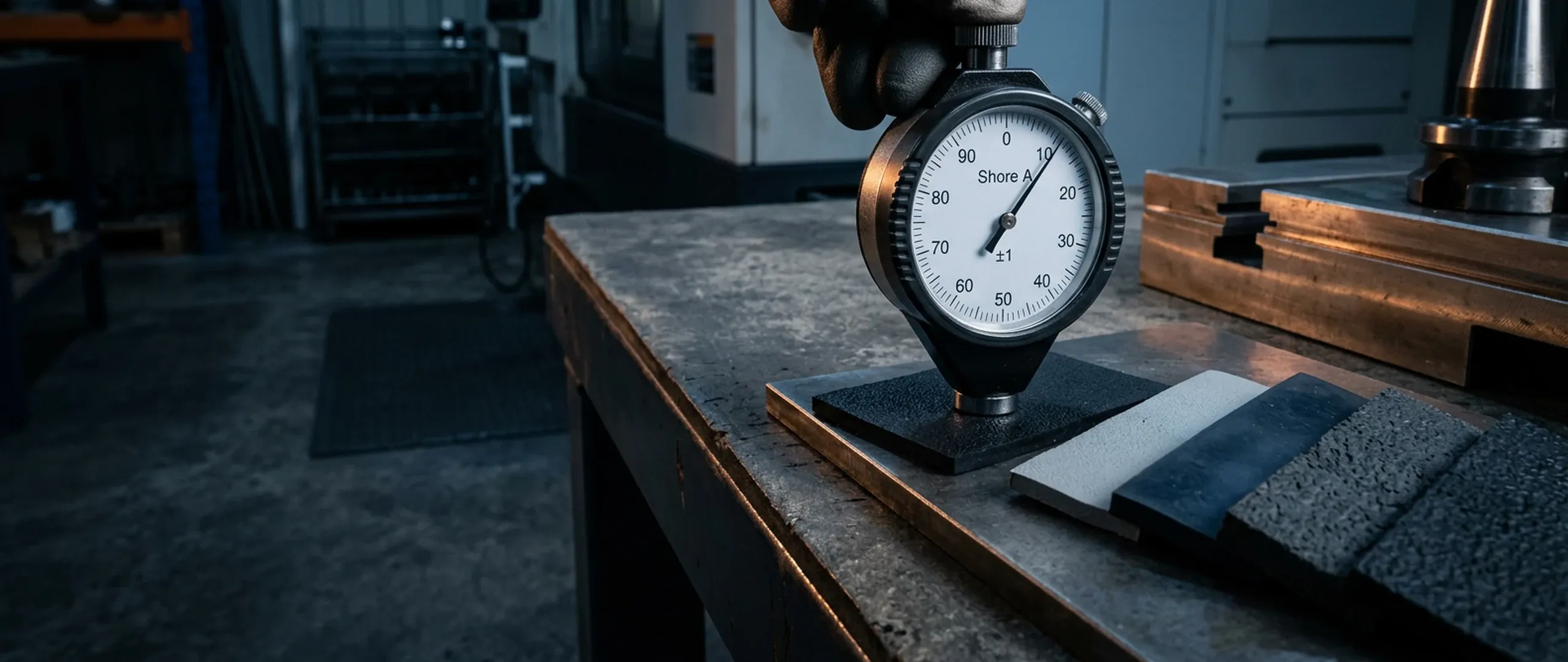
Shore hardness measures a material's resistance to indentation, following ASTM D2240 and ISO 7619-1. A spring-loaded steel pin pushes into the surface under controlled force, and the depth of penetration sets the reading. The whole test takes under five seconds. A reading of 0 means full penetration (no resistance); 100 means zero penetration (maximum resistance).
Softer (Lower Shore A)
Better conformability
- Fills surface imperfections and scratches for a reliable seal
- Lower bolt torque required to achieve compression
- Ideal for low-pressure applications and rough flange surfaces
- Risk: may extrude from the joint under high pressure
Harder (Higher Shore A)
Better extrusion resistance
- Resists being squeezed out of the joint under pressure
- More durable in abrasive or dynamic applications
- Handles higher system pressures
- Risk: requires high bolt loads, may damage fragile flanges
Flange Protection
Selecting the correct hardness is not just about the seal — it's about protecting your hardware. Using a gasket that is too hard can crack delicate PVC, fibreglass, or glass-lined flanges. Conversely, a gasket that is too soft may extrude under pressure, requiring frequent replacement. The right choice balances conformability against extrusion resistance for your specific application.
The Shore A Scale
The Shore A scale runs from 0 (extremely soft) to 100 (extremely hard). Most elastomeric gaskets fall in the 40–80 range. The examples below relate each hardness level to a familiar everyday object.
Gel insole
Extremely soft, almost liquid feel
Art gum eraser
Very soft, high deformation under finger pressure
Pencil eraser
Soft & highly conformable
Rubber band
Medium-soft, general-purpose rubber
Tyre tread
Medium, resilient — common gasket range starts here
Running shoe sole
Standard industrial grade — the most common gasket hardness
Leather belt
Firm, limited flexibility
Shopping trolley wheel
Hard, semi-rigid — approaching Shore D territory
Related Scales
Shore D is used for harder materials — rigid plastics, hard rubber, and semi-rigid composites. There is some overlap: approximately 90 Shore A ≈ 40 Shore D. If a material exceeds 90 Shore A, it is typically reported on the Shore D scale instead. Shore 00 covers extremely soft materials like gels and foams.
Comparative Properties
A side-by-side comparison of seven common gasket elastomers across ten key mechanical and environmental properties. Click a material to highlight its column.
Click a material to highlight its column. Click again to deselect.
Material Profiles
Quick-reference cards for each elastomer family — typical hardness range, operating temperature, key strengths and limitations, and common applications.
Nitrile (Acrylonitrile Butadiene)
40 – 90 Shore A · -40 to +120 °C
Strengths
- + Outstanding oil & fuel resistance
- + Good abrasion & wear resistance
- + Economical & widely available
Limitations
- – Poor ozone & UV resistance
- – Limited high-temperature performance
Typical uses: Petroleum seals, hydraulic systems, fuel handling, general industrial
Neoprene (Chloroprene)
40 – 80 Shore A · -40 to +120 °C
Strengths
- + Good all-round performer
- + Moderate oil, weather & ozone resistance
- + Good flame retardance
Limitations
- – Outperformed by specialist elastomers in each category
- – Moderate cost
Typical uses: Refrigeration, marine, HVAC, weathersealing, general purpose
Ethylene Propylene Diene Monomer
40 – 80 Shore A · -50 to +150 °C
Strengths
- + Weather, ozone, and UV-resistant
- + Outstanding steam & hot water resistance
- + Good acid & alkali resistance
Limitations
- – Very poor oil & fuel resistance
- – Swells in hydrocarbon solvents
Typical uses: Steam systems, water treatment, outdoor exposure, potable water, brake fluids
Fluoroelastomer (Viton®)
60 – 90 Shore A · -20 to +205 °C
Strengths
- + Exceptional heat resistance
- + Outstanding chemical & oil resistance
- + Very low compression set
Limitations
- – Highest cost of common elastomers
- – Limited low-temperature flexibility
- – Poor steam resistance
Typical uses: High-temp chemical processing, aerospace, automotive exhaust, aggressive media
Silicone (Vinyl Methyl Polysiloxane)
30 – 80 Shore A · -60 to +230 °C
Strengths
- + Widest temperature range of any common elastomer (-60 to +230 °C)
- + UV and ozone resistant
- + Biocompatible & food-safe grades available
Limitations
- – Very poor tear & abrasion resistance
- – Poor oil & fuel resistance
- – Not suitable for dynamic seals
Typical uses: Extreme-temperature seals, food & pharma, medical devices, static seals, ovens
Natural Rubber (Polyisoprene)
30 – 80 Shore A · -50 to +70 °C
Strengths
- + Highest tear strength of common elastomers (ASTM D624)
- + High resilience and rebound
- + Low cost
Limitations
- – Very poor oil, ozone & UV resistance
- – Low maximum temperature
Typical uses: Vibration damping, anti-vibration mounts, conveyors, general sealing (non-oil)
Butyl (Isobutylene Isoprene)
40 – 75 Shore A · -50 to +120 °C
Strengths
- + Exceptional gas impermeability
- + Good vibration damping
- + Good acid & chemical resistance
Limitations
- – Poor oil & fuel resistance
- – Very low resilience (slow recovery)
Typical uses: Gas containment, pharmaceutical stoppers, diaphragms, chemical tank liners
Hardness Selection Guide
Choosing the right Shore A hardness depends on your system pressure, flange surface finish, bolt load capacity, and whether the gasket needs to resist extrusion.
Flange Surface Considerations
Smooth, Machined Flanges
Standard or harder gaskets (60–80 Shore A) work well. The smooth surface provides good initial contact even with firmer materials. Higher bolt loads are available to achieve compression.
Rough, Corroded, or Pitted Flanges
Softer gaskets (40–60 Shore A) recommended. The material must conform to surface irregularities to create a seal path. Consider thicker gaskets to accommodate deeper imperfections.
Fragile Flanges (PVC, fibreglass, Glass-Lined)
Soft gaskets (40–60 Shore A) essential. Hard gaskets concentrate stress and can crack fragile flange materials. Full-face gaskets distribute load more evenly than ring-type for these applications.
High-Pressure Systems
Harder gaskets (70–90 Shore A) or anti-extrusion backup rings. Soft gaskets under high pressure can extrude into the gap between flange faces, leading to rapid failure. For pressures above 10 bar, discuss with our team.
Compression Set & Memory
Hardness alone doesn't determine seal performance. Compression set — the ability of a material to recover its shape after being compressed — is equally critical. A gasket with poor compression set (high permanent deformation) will thin over time, losing bolt load and eventually leaking. Fluoroelastomer (FKM) and Butyl (IIR) have low compression set; Natural Rubber has high permanent set. This is a key consideration for applications with thermal cycling or frequent bolt retorquing.
Our Standard Range
Our standard elastomeric gaskets ship in the 60–70 Shore A range — the sweet spot for most industrial flange sealing applications. Custom hardness is available on request.
Standard Gasket Hardness
60 – 70 Shore A (typical)
Unless otherwise specified, our standard elastomeric gaskets are supplied in the 60–70 Shore A range. This provides the best balance of conformability, extrusion resistance, and durability for general industrial flange sealing.
Custom Hardness Available
On request
We can source elastomers from 30 to 90 Shore A across all material families. If your application requires a non-standard hardness, include the Shore A value in your enquiry and we'll confirm availability and lead time.
Not sure which material or hardness? Our engineering team can help you select the right combination based on your operating conditions — temperature, pressure, media, flange type, and bolt load. Include as much detail as possible in your enquiry form and we'll recommend the most suitable material.
For chemical compatibility information, see our Chemical Compatibility Guide.
Explore Further
Disclaimer
This guide is provided for general engineering reference only and does not constitute professional advice, specification, or guarantee of performance. Actual results depend on specific application conditions. Universal Gaskets Pty Ltd accepts no responsibility or liability for decisions made based on this information. For full terms, see our Terms & Conditions.
Property ratings and temperature ranges are based on typical commercial-grade compounds under standard laboratory conditions. Actual performance depends on specific compound formulation, filler systems, cure chemistry, and operating environment. Different manufacturers' compounds of the same generic elastomer type can vary significantly. This guide is for preliminary material selection only and does not constitute a material specification or engineering recommendation.